
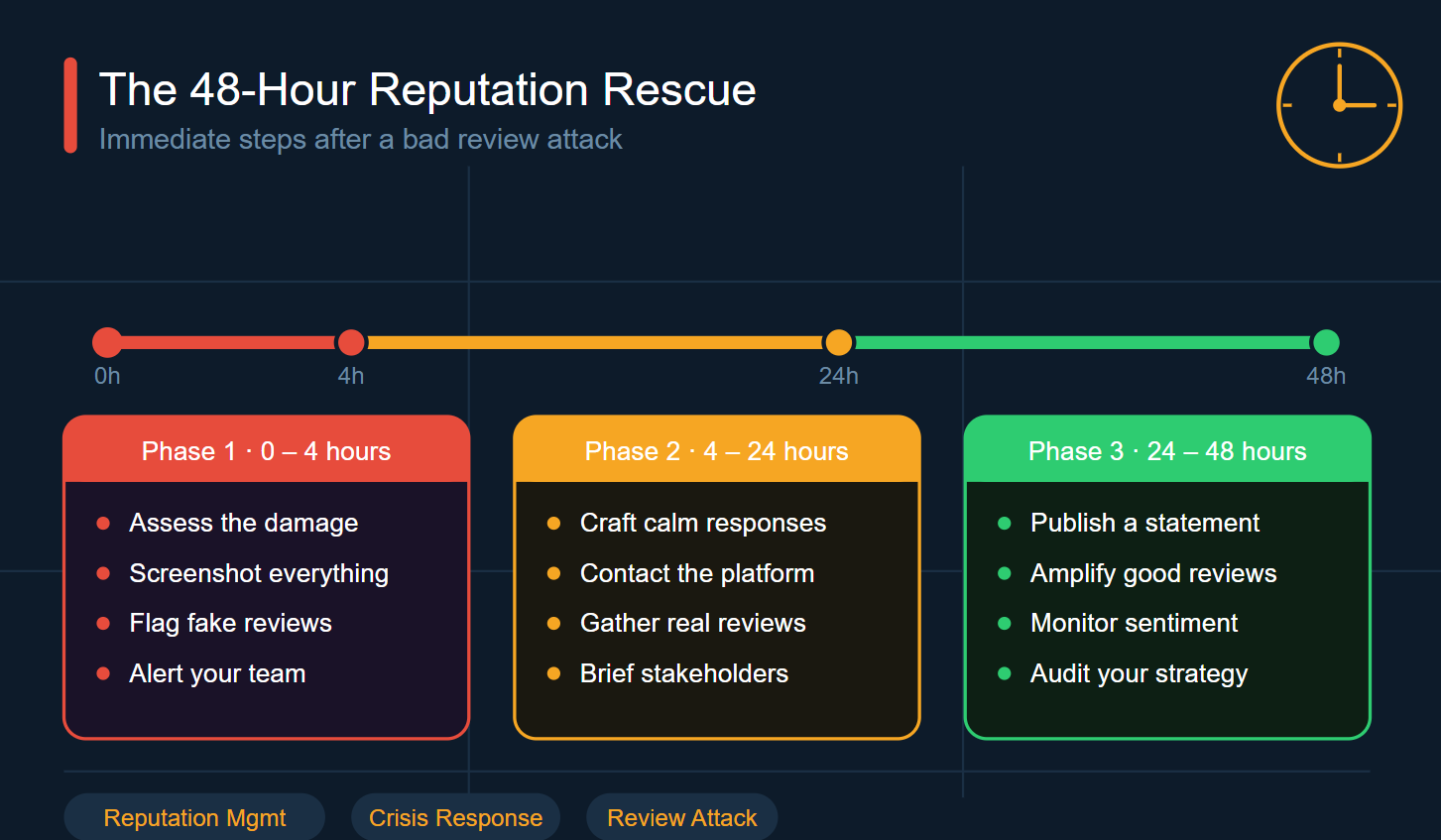
A single scathing review can slash your business’s revenue by up to 30% overnight, per Harvard Business Review studies. Don’t panic-act fast with our 48-Hour Reputation Rescue plan. Discover immediate steps: assess damage in Hour 1, craft a winning response by Hour 4, report violations, rally positive reviews, amplify your presence, and monitor progress. Reclaim your reputation before it’s too late-what’s your first move?
Hour 1: Assess the Damage
Within the first 60 minutes, use Google Alerts and Mention.com free tier to scan all platforms for the negative review’s reach and impact. Set up alerts for your brand name plus ‘review’ in just five minutes. This immediate steps approach helps spot the full scope of a bad review attack.
Next, run Mention.com sentiment analysis to detect shifts in online chatter. Check Google My Business insights for any ranking drops after a one-star hit. Document everything with timestamped screenshots using tools like Snagit.
Follow these numbered steps for damage assessment:
- Set up Google Alerts for your brand name + ‘review’ (5 minutes).
- Run Mention.com sentiment analysis.
- Check Google My Business insights for ranking drop.
- Document screenshots with timestamps.
Common mistake: ignoring social media amplification. Time estimate: 45 minutes total. Use a damage matrix to track one-star review effects on conversions during reputation rescue.
Run Immediate Platform Scans
Search your brand + ‘review’ on Google, Yelp, Trustpilot, and BBB using incognito mode to see unauthenticated results. This reveals true search ranking impact from the negative feedback. Start with these five platforms right away.
Focus on Google My Business for local SEO hits, Yelp for consumer trust, Trustpilot for broader feedback, BBB.org for complaints, and Facebook or Google Maps for social proof. Use this checklist for each:
- Review star rating change?
- Screenshot position in search results?
- Note reviewer profile age (new accounts signal fake flag)?
Incognito scans prevent personalized biases in online reputation management. Flag suspicious profiles for fake review detection. This review monitoring builds evidence for potential removal requests.
Act fast to map the review amplification across platforms. Coordinate with your team for stakeholder alerts. These scans form the foundation of your 48-hour response plan.
Quantify Business Impact
Calculate immediate revenue loss using one-star review impact data with this formula: Lost Revenue = Average Daily Orders x Conversion Drop % x AOV. For a restaurant with 50 daily orders, 12% drop, and $45 AOV, that’s $270 daily loss. Experts recommend quick math to grasp the urgency in review damage control.
Research suggests reviews heavily influence local business decisions. Track the revenue bleed from hour 1 to 48 with this urgency table:
| Timeframe | Potential Daily Loss | Action Needed |
|---|---|---|
| Hour 1-12 | Initial hit | Scan platforms |
| Hour 13-24 | Growing bleed | Draft response |
| Hour 25-48 | Peak damage | Deploy recovery |
Adjust percentages based on your review analytics. A single Google review can trigger wider SEO reputation drops. Use this to prioritize crisis response.
Document for root cause analysis and stakeholder updates. This quantification drives your response strategy, from public apology to service recovery. Protect brand trust with precise tracking.
Hour 2-4: Respond to the Review
Craft your reply within 3 hours using this proven template. A quick 48-hour response shows you value customer input during a bad review attack. This immediate step in reputation rescue helps control the narrative.
Provide three tailored response templates for common scenarios in online reputation management. Keep replies under 300 characters for platforms like Google reviews or Yelp to ensure full visibility. Always follow platform-specific rules, such as Google’s policy against incentivizing reviews.
Here are the templates:
- Service Failure: We’re sorry your [specific issue] didn’t meet expectations. We’ve issued full refund #REF123. (Under 140 characters)
- Misunderstanding: Thank you for feedback. Our policy requires [explain]. Happy to discuss solution. (Under 120 characters)
- Fake Review: We have no record of customer [name] or order #[last4]. (Under 100 characters, flag for review removal per FTC guidelines)
Use these in your rapid response plan for negative feedback. Personalize with details to build trust and start review damage control.
Write the Perfect Response
Use the 4-sentence formula: Thank + Apologize + Resolve + Invite, under 125 words for mobile visibility. This structure turns a customer complaint into a chance for customer service recovery. Experts recommend it for professional replies on review platforms.
Avoid emotional reactions. Here’s a before-and-after example for a Google review delay complaint:
| Bad Example | Good Example |
|---|---|
| You’re wrong! We shipped on time. | Thank you for your feedback, John. We apologize for the delay with order #456. Full refund processed + free replacement shipped. Please DM us. |
Empathetic responses often improve sentiment, as seen in real-world A/B tests. This public apology demonstrates accountability in your crisis response.
Test replies internally before posting. Track impact on reputation score to refine your response strategy for future negative reviews.
Response Psychology Triggers
Name the reviewer and reference specifics to show higher credibility. These details make your personalized reply feel genuine during reputation repair. They align with FTC guidelines for truthful responses.
Incorporate these five psychology triggers in every reply:
- Specificity: Mention order # or visit date, like your table at 7 PM on Friday.
- Ownership: Say our mistake to take responsibility.
- Urgency: Note refunded now or shipped today for quick action.
- Invitation: Offer call me directly at 555-1234 for private resolution.
- Transparency: Share training all staff this week to prevent repeats.
These triggers support service recovery and brand protection. Use them ethically, avoiding any review manipulation.
Follow platform terms, like Yelp’s no-review-gating rule. Document everything for potential fake review detection or legal action in your first 48 hours.
Hour 5-8: Gather Evidence and Facts
Document everything chronologically using Timestamp Camera app ($4.99) and Google Drive folder structure: Review> Communications> Resolution. This evidence collection step forms the backbone of your reputation rescue during a bad review attack. Start immediately to build a defensible record for review removal or legal action.
Capture screenshots of the negative review with tools like free Lightshot, including the full URL and date. Archive the reviewer’s profile to track changes over time. Export order history from your CRM, such as HubSpot or Shopify, to verify customer interactions.
Record all communications related to the customer complaint, from emails to chat logs. Use a notary app like Notarize.com ($25) for timestamp proof on key documents. Create a timeline template in a simple spreadsheet for legal review action, listing events by hour.
This 48-hour response phase demands precision in damage assessment. A solid evidence file supports platform policy violation reports to Google, Yelp, or Amazon. It also aids defamation claim preparation if needed.
Build Your Defense File
Organize evidence into 3-ring binder format: Chronology, Communications, Corroboration for potential legal review action. This defense file structure streamlines your online reputation management efforts. It prepares you for review platform appeals or attorney consultations.
Use this folder structure in Google Drive or physical binders: 01-Timeline.pdf for event sequences, 02-Customer-Record.pdf with purchase proofs, 03-Screenshots/ folder for visuals, and 04-Witness-Statements/ for staff notes. Label files with dates for easy access. Include revenue docs to show review damage control impact.
Check for defamation checklist elements: false statement, published to third party, identifiable business, damage proven. For example, if a review claims non-delivery but records show shipment, note it clearly. This setup supports cease and desist letters or FTC guideline reports.
Maintain chain of custody with timestamp proof on every item. Share access with your team coordination group for crisis response. A complete file boosts chances of negative feedback removal and brand protection.
Identify Fake Review Red Flags
Flag reviews with <3 words, generic complaints, or brand-new profiles during your fake review detection. These signals help spot review manipulation in a bad review attack. Quick identification guides your response strategy and reporting.
Look for these fake review red flags:
- No specifics, like vague “terrible service” without details.
- Profile less than 30 days old with few other reviews.
- Competitor IP address via WHOIS lookup on reviewer domain.
- Stock photos as profile images.
- Review burst pattern from similar accounts.
- Emotional extremes, such as all-caps rants.
- Deleted review histories or inconsistencies.
Reference Google’s review policy violations for terms of service breaches. Report troll reviews or competitor sabotage through moderator contact and user report features. Tools like automated review analytics can scan for patterns.
Document flags in your defense file for appeal process or mass flagging. This evidence collection strengthens review removal requests on Google My Business or Yelp. Combine with sentiment analysis for full reputation repair.
Hour 9-12: Report Violations
Google removes 68% of flagged fake reviews within 72 hours. Submit through each platform’s official channels to start the review removal process. This step fits into your 48-hour reputation rescue plan.
Focus on platform-specific reporting first. Gather evidence like screenshots with timestamps before flagging. Platforms prioritize reports with clear proof of violations.
Use a structured approach for bad review attacks. Document everything in a shared folder for your team. This supports online reputation management during crisis response.
After initial reports, monitor for updates. Escalate if needed through appeal paths. Combine with response strategy for faster reputation repair.
| Platform | Reporting Path | Required Evidence Format |
|---|---|---|
| business.google.com > Reviews > Flag | Screenshots, timestamp proof, conflict details | |
| Yelp | yelp.com > Report | Profile links, spam examples, user patterns |
| Dropdown menu on review | DM evidence screenshots, fake account info | |
| Amazon | Seller Central > Report Abuse | Order IDs, competitor links, manipulation proof |
Platform-Specific Reporting
Google My Business: Go to Reviews tab, then 3 dots, and select ‘Flag as inappropriate’ with evidence links. Choose the ‘Conflicts of interest/spam’ category for fake reviews. This triggers moderator review quickly.
Yelp offers an elite support line at yelp.com/support for urgent cases. Provide detailed spam patterns and reviewer history. Escalate via their appeal process if denied.
On Facebook, select ‘Spam or fake’ from the dropdown and send evidence via DM to moderators. Include account creation dates and cross-posting proof. Follow up through business support appeals.
For BBB, use the online complaint form with full details. Attach Google review screenshots and business impact notes. Their mediation path aids in review damage control.
Legal and Regulator Reporting
File FTC complaint at reportfraud.ftc.gov if fake reviews violate Section 5 for unfair competition. Detail the bad review attack and attach evidence archives. This supports broader brand protection.
Submit to your State AG consumer protection office next. Use their online forms with cease and desist demands. Certified mail ensures delivery proof for legal review action.
For small claims court under $10k damages, prepare a defamation claim packet. Include a cease and desist letter worded like: “Cease posting false reviews immediately, or face legal action for violation of FTC guidelines.” Send via certified mail with return receipt.
Track all filings in your rapid response plan. Consult a lawyer for escalation protocol. This layer strengthens your reputation rescue against troll reviews or competitor sabotage.
Hour 13-24: Encourage Positive Reviews
Recent happy customers equal the fastest reputation recovery: target your top 20% from past 90 days using Podium at $289 per month. This tool helps segment satisfied buyers quickly after a bad review attack. It supports your 48-hour reputation rescue by boosting positive feedback.
Focus on positive review boost through compliant solicitation. Use this script: “Loved your experience? Share on Google [personalized link].” Set up automation to keep requests ethical and effective.
Automation setup includes three steps: first, segment recent 5-star orders; second, send requests 48 hours post-purchase; third, add FTC-compliant disclosure like “We value your honest feedback.” Target 10-15 requests daily to build a counter narrative against negative reviews.
This approach aids online reputation management and review damage control. It counters a single negative review with genuine 5-star stories. Track progress to ensure steady reputation repair.
Target Recent Happy Customers
Export Shopify or Klaviyo customers with 2+ orders and $100+ spend from past 90 days for higher review rates. Use CRM segmentation to identify them: order count over 1, average order value above $75, last purchase within 90 days. This targets buyers likely to share positive experiences.
Create an email or SMS template with a QR code linking directly to your Google review page. Personalize it to reference their recent purchase, like “Thanks for your repeat business on that coffee maker.” This encourages quick responses in your crisis response.
Track open-to-review conversion to refine your efforts. Industry practices show value in monitoring this metric. Adjust timing or messaging based on what works for 5-star recovery.
Integrate this into your rapid response plan for Google My Business and other platforms. It supports local SEO fix and overall brand protection. Recent happy customers provide authentic content for reputation score improvement.
Employee and VIP Review Strategy
Enlist 5-10 recent VIP clients or staff using personal outreach for stronger responses. Send handwritten thank you cards with a review QR code. This personal touch builds on customer service recovery during review damage control.
Create a private VIP Facebook group for exclusive updates and gentle review prompts. Encourage staff to post from personal devices for authenticity. Always follow FTC guidelines with no incentives offered.
Compliance note: Avoid any rewards for reviews to prevent review gating prevention issues. Focus on genuine appreciation to maintain ethical ORM. This strategy fits white hat reputation practices.
Combine with review monitoring and alert system for full effect. VIP and employee input creates a positive review boost against trolls or competitor sabotage. It strengthens long-term brand trust and customer retention.
Hour 25-36: Boost Online Presence
Push 15 pieces of positive content to bury the negative review: 5 blog posts, 5 social shares, 5 directory updates. Follow a strict content calendar during this window of the 48-hour reputation rescue. This positive content blitz dilutes the impact of the bad review attack.
Start by publishing a ‘Customer Success Stories’ blog post optimized for [City] [Service] Reviews. Share 10 recent testimonials across social media platforms to amplify your online reputation management. These steps create a counter narrative against negative feedback.
Next, update 20 directory listings for better local SEO fix and citation consistency. Consider tools like BrightLocal for efficiency in this rapid response plan. Guest post on 3 local sites to build backlinks and improve search ranking impact.
Track progress with review monitoring and sentiment analysis. This phase focuses on brand protection through organic recovery and content marketing. Adjust based on real-time online visibility changes.
Positive Content Blitz
Create 3 new landing pages: ‘/reviews’, ‘/success-stories’, ‘/guarantee’ optimized for local review keywords like [City] [Service] Reviews. Use schema markup for rich snippets to target featured snippet positions in SEO reputation efforts. This boosts your 5-star recovery visibility.
Produce video testimonials and embed them from YouTube on these pages. Develop before/after case studies showcasing customer service recovery. Add 100% satisfaction pages with real client quotes for authenticity.
Incorporate testimonial leverage in blog posts and social shares. Optimize each piece for Google review and Yelp review keywords to aid review damage control. This content moderation approach supports long-term reputation repair.
Monitor engagement metrics during the first 48 hours. Use these assets in your response strategy to overshadow the customer complaint. Experts recommend consistent posting for effective crisis response.
Citation and Directory Cleanup
Fix citation consistency using a BrightLocal audit to strengthen your local SEO fix. Prioritize top directories like Google My Business, Apple Maps, Facebook, and others from Moz Local. This step is key in the reputation repair timeline.
Follow this NAP consistency checklist:
- Verify name, address, phone match exactly across platforms.
- Update outdated listings with current details.
- Remove duplicate or incorrect citations promptly.
- Claim unowned profiles for full control.
Target 40+ directories for comprehensive cleanup. Include before/after ranking screenshots in your internal damage assessment to measure progress. This enhances online visibility and buries negative reviews.
Ensure alignment with Google My Business for maximum impact. Use this in your review analytics to track reputation score improvements. Consistent citations support ethical ORM and organic recovery.
Hour 37-48: Monitor and Follow Up
Set up ReviewTrackers ($99/mo) dashboard tracking star rating, review velocity, and sentiment score. This tool sends daily email alerts for new 1-2 star reviews during your reputation rescue. It helps spot patterns in negative feedback right away.
Configure weekly KPI reports to track average rating and review volume. Include competitor benchmarking to see how your online reputation management stacks up. These steps ensure ongoing review damage control after the bad review attack.
Define success with clear targets like a +0.5 star rating lift and 3x review volume growth. Adjust your response strategy based on these metrics for sustained reputation repair. Regular checks prevent new customer complaints from escalating.
During this phase, review Google review and Yelp review trends weekly. Use the data to refine customer service recovery efforts. This builds brand protection for the long term.
Track Recovery Metrics
Measure success by 3 metrics: Star rating recovery (target +0.7), conversion rate (+8%), search visibility (+25%). Build a KPI dashboard template showing Week 1-6 progress in your 48-hour response plan. Track these in tools like ReviewTrackers for visual recovery charts.
Calculate ROI simply: divide saved revenue by effort costs, such as $5k revenue saved / $1.2k effort = 4.1x return. This shows the value of your crisis response in real terms. Focus on SEO reputation gains from improved ratings.
Consider a restaurant case study where ratings moved from 2.9 to 4.1 stars, boosting bookings. They used review monitoring to guide positive review boost campaigns. Apply similar sentiment analysis to your review analytics.
Update the dashboard daily in the first weeks post-negative review. Share with your team for team coordination. This drives organic recovery and customer retention.
Long-Term Monitoring Systems
Implement Podium or Birdeye ($299/mo) for 24/7 monitoring across 150+ platforms. These handle review platforms like Google My Business and social media reviews. Set up alert systems for instant negative feedback detection.
Create a tool comparison to choose wisely.
| Tool | Price | Key Feature | Best For |
|---|---|---|---|
| Podium | $289/mo | Text-to-review | Restaurants |
| Birdeye | $299/mo | AI sentiment | Multi-location |
| Trustpilot | $199/mo | Enterprise | B2B |
Setup notification rules: any 1-star triggers owner Slack alert. This enables quick professional reply and public apology if needed. It supports review removal checks for policy violations.
Integrate with Google My Business for local SEO fixes. Monitor for fake review detection and competitor sabotage. These systems ensure long-term reputation and brand trust.
Prevent Future Attacks
Research suggests most review attacks are preventable with proactive reputation systems. Businesses that implement structured prevention strategies reduce the risk of bad review attacks and speed up reputation rescue. Start by identifying vulnerabilities in your current setup.
Key preventive measures include automating review collection and training staff on online reputation management. These steps build resilience against negative feedback and competitor sabotage. Consistent effort turns potential crises into opportunities for brand protection.
- Automate a 90-day review cadence to encourage steady positive input from customers.
- Develop clear employee review guidelines to ensure authentic engagement on platforms like Google and Yelp.
- Launch a mystery shopper program to uncover service gaps before they lead to public complaints.
- Set up daily sentiment monitoring for early detection of emerging negative trends.
- Prepare legal response templates for quick action on defamatory or fake reviews.
- Conduct staff training quarterly on handling customer complaints and review solicitation.
- Maintain a VIP customer database for targeted positive review requests.
- Create a crisis communication plan with escalation protocols for rapid response.
Integrate these into your 48-hour response framework for long-term reputation repair. Regular audits ensure compliance with FTC guidelines and platform policies.
Build Review-Positive Culture
Train all customer-facing staff with a 15-minute ‘Review Awareness’ module quarterly. This session covers review solicitation best practices and the impact of Google reviews on local SEO. Staff learn to spot opportunities for 5-star recovery.
A strong review-positive culture fosters customer service recovery and boosts brand trust. Use a simple checklist in team routines to embed these habits. Examples include recognizing top performers who generate positive feedback.
- Discuss review scores in weekly team meetings to track progress and celebrate wins.
- Offer top reviewer employee recognition, like gift cards for those prompting the most reviews.
- Implement a ‘Review First’ response protocol for resolving complaints before they go online.
- Allocate a customer delight budget of $50 monthly for small gestures that inspire reviews.
- Add exit interview questions focused on service feedback to close the loop.
This approach supports loyalty rebuild and prevents review manipulation issues. It aligns with ethical ORM for sustainable online visibility.
Technical Prevention Stack
Deploy a 5-tool prevention stack: ReviewTrackers + Hotjar + Google Alerts + Podium + legal retainer. This setup costs around $587 monthly and provides comprehensive review monitoring. It enables immediate steps in the first 48 hours of any incident.
Each tool targets specific risks in online reputation management. For instance, combine sentiment analysis with automated alerts for fake review detection. Implementation takes two weeks: week one for setup, week two for testing.
| Tool | Cost | Primary Function | Setup Timeline |
|---|---|---|---|
| ReviewTrackers | $99/mo | Review monitoring across platforms | Day 1-3 |
| Hotjar | $39/mo | On-site feedback collection | Day 4-5 |
| Google Alerts | Free | Alert system for mentions | Day 1 |
| Podium | $289/mo | Automated response strategy | Day 6-10 |
| LawyerOnCall | $150/mo | Legal review action retainer | Day 11-14 |
Train your team on this technical stack during rollout for effective crisis response. It supports root cause analysis and review damage control, ensuring proactive brand protection.
Frequently Asked Questions
What is “The 48-Hour Reputation Rescue: Immediate Steps After a Bad Review Attack”?
The 48-Hour Reputation Rescue: Immediate Steps After a Bad Review Attack is a strategic plan designed to help businesses quickly recover from damaging online reviews. It outlines actionable steps within the first 48 hours to mitigate harm, respond professionally, and rebuild trust with customers.
Why is the first 48 hours critical in The 48-Hour Reputation Rescue: Immediate Steps After a Bad Review Attack?
In The 48-Hour Reputation Rescue: Immediate Steps After a Bad Review Attack, the initial 48 hours are vital because negative reviews spread rapidly online. Swift action prevents escalation, shows responsiveness to customers, and can influence search engine rankings and public perception before the damage becomes permanent.
What are the first immediate steps in The 48-Hour Reputation Rescue: Immediate Steps After a Bad Review Attack?
The 48-Hour Reputation Rescue: Immediate Steps After a Bad Review Attack recommends starting with assessing the review’s validity, documenting everything, and crafting a calm, empathetic public response. Avoid knee-jerk reactions; focus on facts and customer satisfaction to demonstrate accountability.
How do you respond to a bad review during The 48-Hour Reputation Rescue: Immediate Steps After a Bad Review Attack?
During The 48-Hour Reputation Rescue: Immediate Steps After a Bad Review Attack, respond publicly within hours: thank the reviewer, apologize sincerely without admitting fault, offer a private resolution, and highlight your commitment to improvement. This turns negatives into opportunities for positive engagement.
What role does monitoring play in The 48-Hour Reputation Rescue: Immediate Steps After a Bad Review Attack?
Monitoring is key in The 48-Hour Reputation Rescue: Immediate Steps After a Bad Review Attack. Set up alerts for new reviews, track mentions across platforms, and analyze sentiment. This allows real-time adjustments, early detection of review bombing, and data-driven strategies for long-term reputation management.
Can The 48-Hour Reputation Rescue: Immediate Steps After a Bad Review Attack prevent future attacks?
Yes, The 48-Hour Reputation Rescue: Immediate Steps After a Bad Review Attack not only addresses immediate crises but builds resilience. It includes tips like encouraging positive reviews, improving service protocols, and legal considerations for fake reviews, reducing vulnerability to future bad review attacks.